

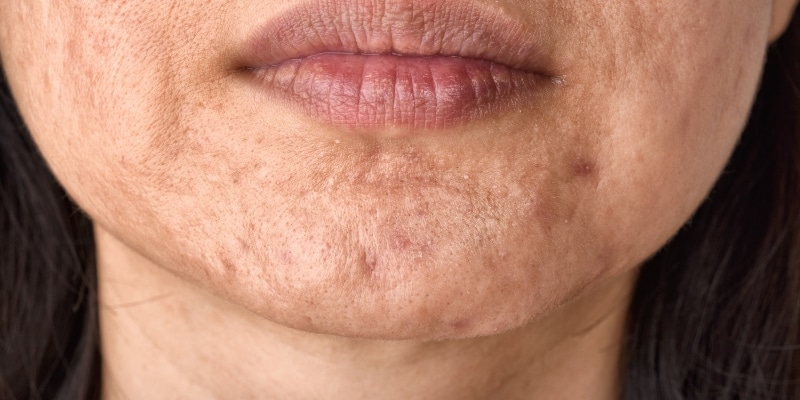
Boxcar acne scars are a type of atrophic scar that appears as broad, rectangular or oval depressions with well-defined edges. Unlike rolling scars, which are wave-like, or ice pick scars, which are narrow and deep, boxcar scars are wider, shallow to moderately deep, and often more noticeable in areas like the cheeks and temples.
Treating boxcar scars effectively requires procedures that resurface the skin, stimulate collagen production, and smooth scar edges. This article discusses the best treatment options, how they work, expected results, and considerations for Malaysian patients.
Understanding Boxcar Scars
Boxcar scars are typically:
- Well-defined, round or oval depressions
- Wider than ice pick scars but shallower
- Often caused by severe inflammatory acne
- Resistant to topical creams alone
These scars create an uneven skin texture and can cast shadows, making them visually prominent. Proper treatment must target both depth and surface texture.
Laser Treatments for Boxcar Scars
Laser therapy is the most commonly recommended treatment for boxcar scars because it can resurface the skin, remodel collagen, and improve scar edges.
Types of Laser Treatments
- Ablative Fractional Lasers
- Removes microscopic columns of skin
- Stimulates strong collagen remodeling
- Improves texture, scar edges, and pigmentation
- Non-Ablative Fractional Lasers
- Heats the dermis without removing surface skin
- Stimulates collagen with minimal downtime
- Safer for darker skin types common in Malaysia
How Laser Helps Boxcar Scars
- Smooths the sharp edges of boxcar scars
- Improves skin texture and firmness
- Stimulates collagen production in the dermis
- Reduces visible depth of the scar over multiple sessions
Microneedling as an Alternative or Complement
Microneedling can complement laser treatment or serve as an alternative for patients with mild to moderate boxcar scars.
- Uses fine needles to create micro-injuries that stimulate collagen production
- Improves overall skin texture and firmness
- Minimal downtime and lower risk of pigmentation compared to ablative lasers
Microneedling is particularly useful for Malaysian patients with Fitzpatrick III–V skin types, reducing the risk of post-inflammatory hyperpigmentation.
Combination Treatments
For optimal results, combination therapy is often recommended for boxcar scars:
- Laser + Microneedling: Improves both scar depth and overall skin texture
- Laser + PRP (Platelet-Rich Plasma): Enhances collagen stimulation and accelerates healing
- Subcision + Laser: Used if mild tethering exists around the scar
Combination treatments allow practitioners to address multiple aspects of scarring, ensuring smoother and more natural results.
Treatment Sessions and Recovery
- Laser: Usually 3–5 sessions spaced 4–6 weeks apart
- Microneedling: 3–6 sessions spaced 4–6 weeks apart
- Recovery varies depending on treatment type:
- Non-ablative laser: 1–3 days redness
- Ablative laser: 7–10 days peeling and redness
- Microneedling: 1–3 days mild redness
Visible improvement develops gradually as collagen remodels over 2–6 months.
Safety Considerations for Malaysian Skin
- Post-inflammatory hyperpigmentation is a concern for darker skin types
- Conservative laser settings reduce the risk of pigmentation
- Sun protection is critical after treatment
- Active acne should be controlled before starting scar procedures
Both laser and microneedling are safe and effective for Malaysian Fitzpatrick III–V skin types when administered by trained professionals.
Limitations
- Multiple sessions are required for noticeable improvement
- Complete removal is unlikely
- Results depend on scar depth, type, and skin healing response
- Realistic expectations are essential: the goal is visible improvement, smoother skin, and less pronounced scar edges
Conclusion
Boxcar scars are broad, well-defined depressions caused by inflammatory acne. Laser therapy remains the gold standard, targeting scar edges, improving texture, and stimulating collagen. Microneedling and PRP can complement lasers, especially for mild to moderate scars or patients concerned about downtime.
A combination of therapies often yields the best results, particularly for patients with mixed scar types. Proper assessment, professional administration, and staged sessions ensure safe and effective outcomes for Malaysian skin types, producing smoother skin and reduced scar visibility.
Frequently Asked Questions
1. What is the best treatment for boxcar acne scars?
Fractional laser therapy is considered the gold standard, as it improves scar edges, texture, and stimulates collagen.
2. Can microneedling treat boxcar scars?
Yes, microneedling can improve texture and firmness, especially for mild to moderate scars.
3. Can combination treatments improve results?
Yes. Combining laser with microneedling or PRP can enhance collagen stimulation and overall skin smoothness.
4. How many sessions are needed for boxcar scars?
Laser typically requires 3–5 sessions, while microneedling may require 3–6 sessions, spaced 4–6 weeks apart.
5. Is laser safe for Malaysian skin types?
Yes, with conservative settings and proper post-treatment care, lasers are safe for Fitzpatrick III–V skin types.
