

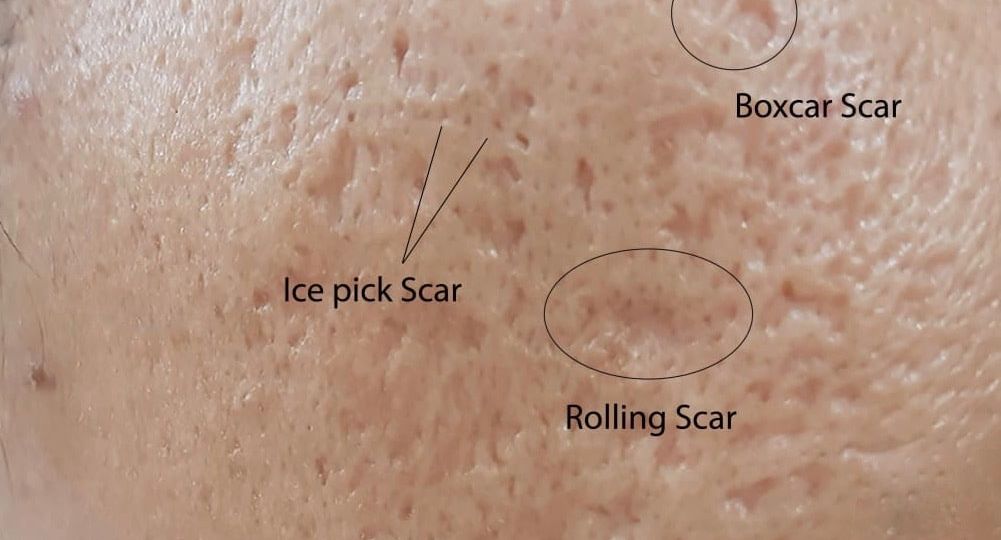
Acne scars vary widely in appearance and severity, and understanding their types is essential for effective treatment. Each scar type reflects how the skin healed after inflammation and dictates which treatment approach will be most effective. In Malaysia, with its diverse skin types (Fitzpatrick III–V), recognizing scar types also helps clinicians prevent post-inflammatory pigmentation while maximizing results.
1. Atrophic Scars
Atrophic scars are the most common type of acne scars and are caused by loss of collagen during the healing process. These scars appear as depressions in the skin and can vary in depth and width.
a. Ice Pick Scars
- Appearance: Narrow (<2 mm), deep, and sharply defined pits that resemble tiny holes in the skin.
- Cause: Severe localized inflammation destroys a small portion of the dermis.
- Clinical Note: Ice pick scars often penetrate deep into the dermis, making them challenging to treat. They are resistant to superficial treatments and often require TCA CROSS, fractional lasers, or combination therapy.
- Common Location: Cheeks, perioral area, and temples.
b. Boxcar Scars
- Appearance: Wider depressions (1.5–4 mm) with defined edges and flat bases.
- Cause: Broader areas of dermal destruction during inflammatory acne.
- Clinical Note: Boxcar scars can be shallow or deep. Shallow boxcar scars respond well to laser resurfacing, chemical peels, or microneedling, while deeper ones may require subcision or combination therapy.
- Common Location: Cheeks and temples.
c. Rolling Scars
- Appearance: Wave-like, uneven texture due to fibrous bands tethering the dermis to subcutaneous tissue.
- Cause: Fibrotic tissue pulls the skin downwards, creating an undulating surface.
- Clinical Note: Rolling scars are often best treated with subcision, sometimes combined with microneedling or fillers to restore smoothness.
- Common Location: Cheeks and jawline.
2. Hypertrophic and Keloid Scars
These scars are caused by excessive collagen deposition during the healing process. Unlike atrophic scars, they are raised above the skin surface.
- Hypertrophic Scars: Remain within the boundaries of the original acne lesion.
- Keloid Scars: Extend beyond the lesion and can grow larger than the original area.
- Cause: Overactive fibroblasts produce excessive collagen in response to skin injury.
- Clinical Note: Less common on the face but prevalent on the jawline, chest, and shoulders. Medium to darker skin types, like many Malaysians, have a higher tendency for keloid formation.
- Treatment Options: Steroid injections, silicone sheets, laser therapy, or surgical revision in severe cases.
3. Post-Inflammatory Hyperpigmentation (PIH)
While not technically a scar, PIH often coexists with atrophic or hypertrophic scars, making skin appear uneven.
- Appearance: Flat, darkened patches or spots.
- Cause: Melanin overproduction triggered by inflammation from acne.
- Clinical Note: PIH does not involve dermal structural damage, so it is treatable with topical agents (hydroquinone, retinoids, or azelaic acid), sun protection, or targeted laser therapy.
- Relevance in Malaysia: Darker skin tones are more prone to persistent pigmentation, making post-treatment care and sun protection critical.
4. Mixed Scar Types
Many patients present with multiple scar types simultaneously. For example:
- Ice pick scars on the cheeks
- Rolling scars near the jawline
- Hyperpigmentation patches from prior inflammation
Clinical Implication: Mixed scars require tailored combination therapy, often involving multiple procedures over several months to achieve optimal results.
5. Scar Severity and Grading
Clinicians often grade acne scars to guide treatment planning:
- Mild Scars: Small, shallow depressions; minimal impact on skin texture.
- Moderate Scars: Wider or deeper depressions; rolling scars present; some pigmentation.
- Severe Scars: Deep ice pick or boxcar scars; combination of atrophic and hypertrophic features; extensive pigmentation.
Treatment approaches vary depending on severity, emphasizing that personalized assessment is critical.
6. How Scar Types Affect Treatment Choice
Different scar types respond better to specific interventions:
- Ice Pick → TCA CROSS, fractional lasers, sometimes punch excision
- Boxcar → Subcision, microneedling, laser resurfacing, chemical peels
- Rolling → Subcision, fillers, microneedling
- Hypertrophic/Keloid → Steroid injections, silicone sheets, surgical revision
- PIH → Topical lightening agents, laser therapy, sun protection
Combination therapy is often necessary, especially for patients with multiple scar types.
7. Malaysia-Specific Considerations
- Skin Type: Fitzpatrick III–V skin is more prone to pigmentation; treatments must minimize post-inflammatory hyperpigmentation.
- Climate: Heat and humidity can affect healing; sun protection is critical.
- Treatment Access: Certain advanced modalities like fractional CO2 lasers or RF microneedling may be preferred for deeper scars common in Malaysian patients.
Conclusion
Acne scars are diverse in appearance and mechanism. Understanding what acne scars are and how they form be it atrophic (ice pick, boxcar, rolling), hypertrophic/keloid, and pigmentation-related is essential for effective treatment planning.
Patients often present with mixed scar types, requiring combination therapy tailored to scar depth, location, and skin type. In Malaysia, darker skin tones and tropical conditions must also be considered to prevent pigmentation and optimize healing.
Proper classification and early intervention enable clinicians to design targeted, effective treatment plans, improving both skin texture and patient confidence. Recognizing scar types is the first step toward safe, predictable, and meaningful acne scar management.
Frequently Asked Questions
1. What are the main types of acne scars?
The main types of acne scars are:
-
Atrophic scars – depressions caused by collagen loss (ice pick, boxcar, rolling)
-
Hypertrophic and keloid scars – raised scars from excess collagen
-
Post-inflammatory hyperpigmentation (PIH) – flat, dark marks that often accompany scars
2. How do ice pick scars differ from boxcar scars?
-
Ice pick scars are narrow, deep, and sharply defined, resembling small holes in the skin.
-
Boxcar scars are wider depressions with defined edges and flat bases.
Both are caused by dermal destruction from inflammatory acne, but their shape and depth determine the best treatment approach.
3. What causes rolling acne scars?
Rolling scars form when fibrotic bands tether the dermis to subcutaneous tissue, creating a wave-like, uneven skin surface. They are usually the result of chronic inflammation and require subcision or combination therapy for improvement.
4. Are hypertrophic and keloid scars common on the face?
No, hypertrophic and keloid scars are less common on the face but can appear on the jawline, chest, and shoulders. They occur due to overproduction of collagen during healing, and patients with darker skin types, including many Malaysians, are at higher risk.
5. Is post-inflammatory hyperpigmentation a true acne scar?
No. PIH does not involve structural damage to the dermis, so it is not technically a scar. However, it often accompanies acne scars, making skin appear uneven, and requires topical treatments, sun protection, or laser therapy for improvement.
6. Can a person have multiple types of acne scars at once?
Yes. Many patients present with mixed scar types, such as ice pick scars on the cheeks, rolling scars on the jawline, and pigmentation patches. Combination therapy is usually required to address all types effectively.
